
Table Of Contents
Bicycle Light Battery Runtime: How to Compare Modes, Capacity and Charging
Bike light battery runtime should be compared at the brightness mode you will actually use—not by the longest number on the box. A rechargeable light may run for two or three hours on high, much longer on low, and longer again in a flash mode. Those figures describe different jobs. A flash mode can make a rider conspicuous, but it is not a substitute for a steady beam when the rider needs to see an unlit road.
Start with the time you expect to spend in darkness, add a reserve, and identify the lowest steady mode that still provides a useful beam for the route. Then compare its published runtime, the way output changes during discharge, the battery indicator and the charging input. Battery capacity in mAh is supporting information, not a direct conversion to hours.
What Does Bike Light Battery Runtime Mean? The Short Answer
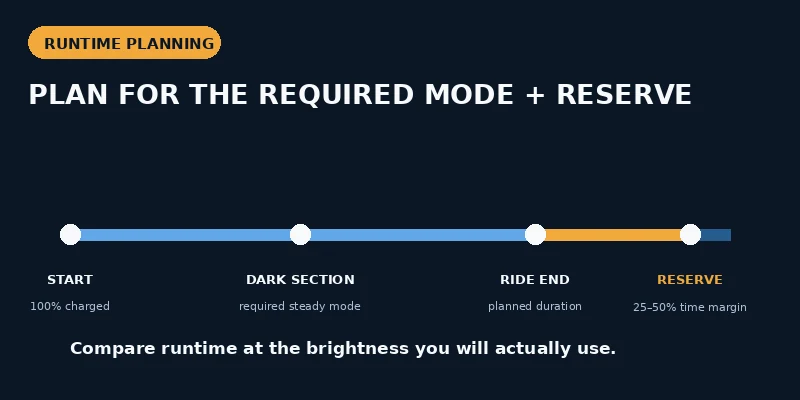
Bike light battery runtime is the time a light operates in a defined mode under defined test conditions. For real ride planning, the useful definition is narrower: how long the light delivers enough steady illumination for the rider’s darkest route segment.
A good selection process begins with ride duration, not battery size. If a commute includes 50 minutes after dark, do not choose a light that claims “up to 20 hours” without checking which mode creates that figure. Find the runtime of the required steady mode. Add a practical reserve for delays, route changes, stops, battery ageing and conditions that differ from the laboratory test. A 25–50 percent time margin is a planning convention, not a product guarantee.
Runtime is also not the same as service life. Runtime describes one charge. Service life describes how battery capacity changes over months and charge cycles. This article addresses per-charge performance; when purchasing for fleets or retail programs, replacement policy and cell serviceability deserve a separate check.
How Bike Light Battery Runtime Changes Across Steady and Flash Modes
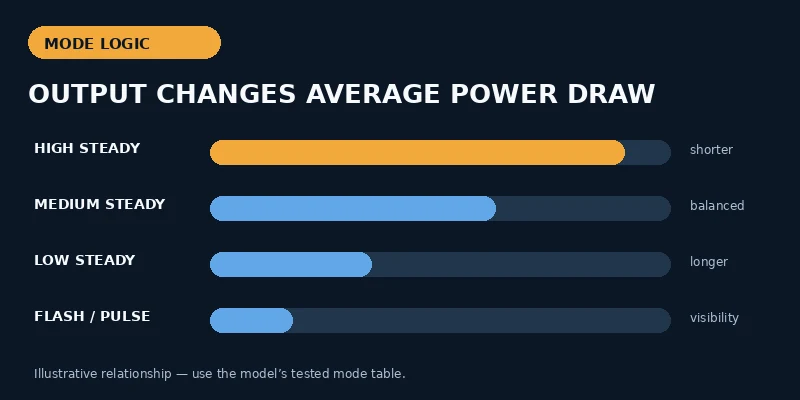
Bike light battery runtime changes because each mode asks the LED and driver for a different average power. High steady mode normally consumes energy fastest. Medium and low steady modes reduce output and extend time. Flash and breathing patterns switch or vary the LED, so their average power can be much lower even if the instantaneous pulse is bright.
The result is not necessarily proportional. Halving the lumen setting does not guarantee exactly twice the runtime. LED efficiency changes with drive current, and the control electronics, battery voltage, thermal behavior and programmed mode all influence the result. This is why a mode table is more reliable than a calculation based only on maximum lumens.
The intended use also matters. High steady is relevant when a rider must illuminate an unlit road at speed. Medium may cover a city route with occasional dark sections. Low can preserve energy under continuous street lighting. A daytime flash is designed for conspicuity in ambient light. On a dark road, a steady beam provides a stable view and makes distance judgment easier; local rules may also govern flash use.
Compare front and rear lights separately. A front light doing road illumination uses far more output than a rear visibility light, so their hour figures are not directly comparable even when both are rechargeable LED bike lights.
Why Bicycle Light Battery Capacity in mAh Does Not Equal Runtime
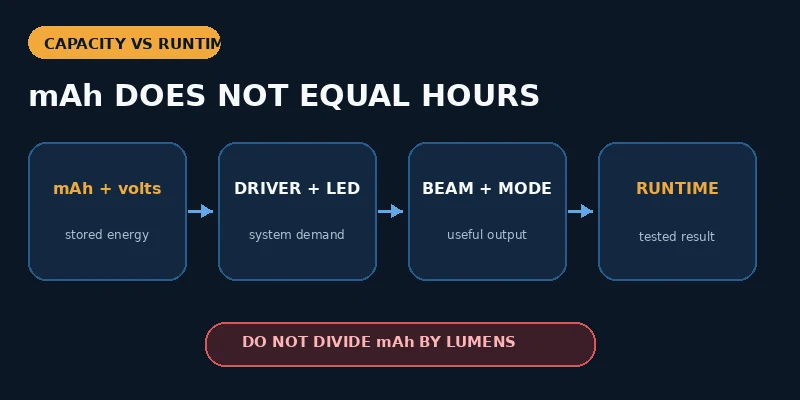
Bicycle light battery capacity is often listed in milliamp hours, or mAh. The figure represents electric charge at the battery’s specified conditions. It does not state the energy available unless voltage is also known, and it does not state how quickly the light consumes that energy.
When nominal voltage is known, watt hours provide a more useful energy comparison: amp hours multiplied by volts. A 2,500 mAh battery is 2.5 Ah; at a nominal 3.6 V, its nominal energy would be about 9 Wh. Even that number does not predict exact runtime. The LED driver has conversion losses, the lamp may regulate or step down output, the battery’s usable voltage range is limited, and temperature and ageing can reduce available capacity.
Do not divide mAh by lumens. Lumens are light output, while mAh is charge capacity; they are not compatible units. Two lights with the same battery capacity can run for different times because their optics, LEDs, electronics and modes differ. Two batteries with the same mAh but different nominal voltage can store different energy.
For purchasing, record capacity, battery format and voltage, but judge the product by a tested runtime table for each output mode. If the supplier publishes only one “up to” number, request the full mode data.
How Output Regulation and Heat Affect Rechargeable Bike Light Runtime
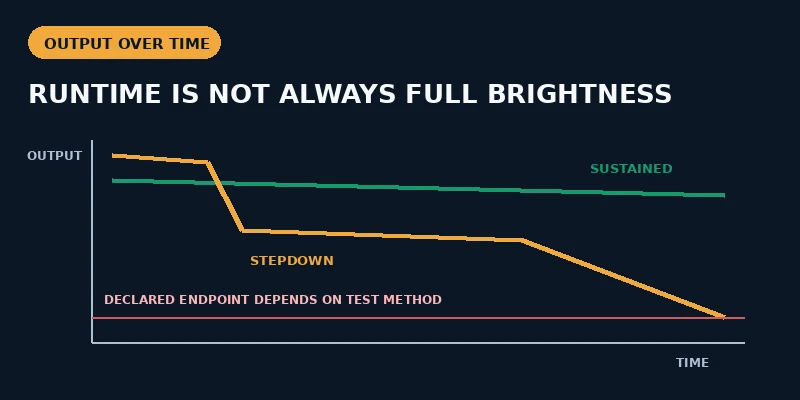
Rechargeable bike light runtime can look generous even when maximum output is brief. A high-power LED and driver create heat. Some products reduce output as the housing warms, as voltage falls, or as part of a programmed power-management strategy. The rider may still have light after several hours, but not necessarily at the level seen at switch-on.
Test definitions matter. Under the current ANSI/PLATO FL 1 standard, runtime for a standard operating mode is measured until output falls to a defined fraction of its initial value. That means a published runtime should not automatically be read as “full brightness for every minute.” A manufacturer using another protocol may use a different endpoint.
Ask for a runtime curve when sustained performance matters. The curve shows output over time and can reveal an early stepdown, a stable plateau and low-battery behavior. Record ambient temperature, airflow, sample battery, mode and endpoint. For an OEM project, approve both the initial output and the minimum acceptable output at relevant times—for example after 15, 60 and 120 minutes—rather than approving only a peak lumen result.
Do not infer a thermal stepdown for a specific CONWICO model unless it has been tested or documented. The correct action is to request the curve for the production sample.
How to Read Rechargeable LED Bike Light Modes for Real Rides
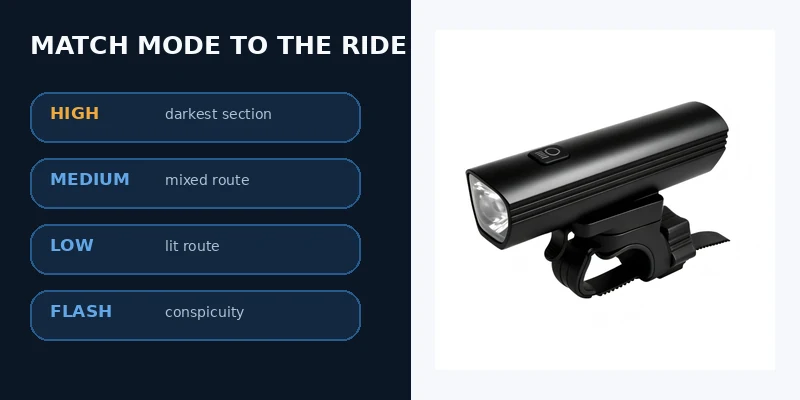
Rechargeable LED bike light modes should have distinct, understandable jobs. A rider wearing gloves should be able to select the required steady output without repeatedly passing through a disruptive flash pattern. Mode memory, a separate flash group or a clear indicator can improve usability, but only if the behavior is documented and tested.
Read a mode table horizontally. For each row, connect four fields: output, pattern, approximate runtime and intended environment. Then identify the row that serves the darkest segment of the ride. If the table contains only names such as “Eco,” “Standard” and “Boost,” request the lumen output and test conditions behind those names.
Next, test transitions. Does the light power on in the last mode or a default mode? Is maximum output continuously available, or is it a timed boost? What happens when the charge becomes low? Does the light step down, flash a warning or shut off? Can the rider interpret the control without looking away from the route?
For bike lights for night riding, steady high and medium modes usually determine whether the lamp can illuminate the route. Flash-mode hours should be reported separately and should not be used to claim the same illumination runtime.
What USB Rechargeable Bike Lights Charging Specifications Actually Tell You
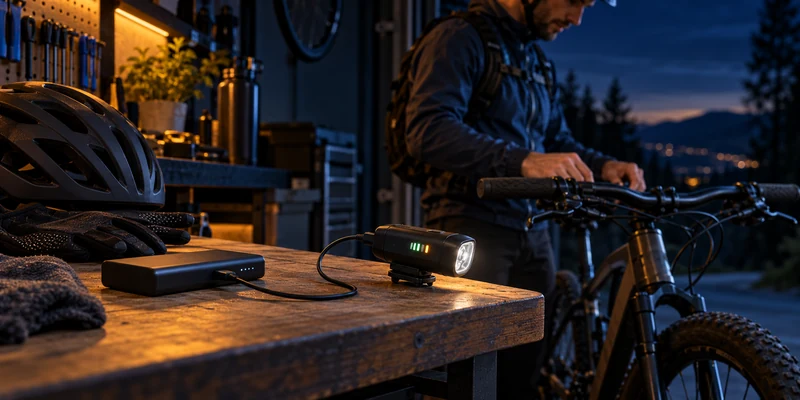
USB rechargeable bike lights should list more than a connector name. “Type-C” describes the physical connector family; it does not by itself guarantee USB Power Delivery, rapid charging, a particular current or pass-through operation. USB-IF guidance distinguishes the connector from optional power and performance capabilities.
Check the specified input voltage and current, the estimated charge time, charging indicator behavior and whether the lamp must be switched off. If ride planning depends on a power bank, confirm in writing that the light can operate while charging and which modes remain available. Do not assume pass-through charging simply because the port is Type-C.
The OH1C-600 page specifies a Type-C port and an input of 5 V/1 A ±0.2. It does not publish a charge time or a pass-through operating claim. Those values should remain “not provided” until CONWICO confirms them; calculating a charge time from 2,500 mAh and 1 A would ignore charging losses and the changing current near full charge.
After a wet ride, follow the product instructions before opening or using the charging port. An IP water rating and a connector cover do not make unsafe charging practices acceptable. For a product brief, include port protection, cable fit, indicator states and the expected charger as test items.
How a Bicycle Light Battery Indicator Helps Plan a Night Ride
A bicycle light battery indicator converts stored energy into a decision the rider can use. The most useful indicators show several bands or an estimated remaining time, remain readable in daylight and do not create glare at night. A single late red warning may arrive too close to the end for a long unlit section.
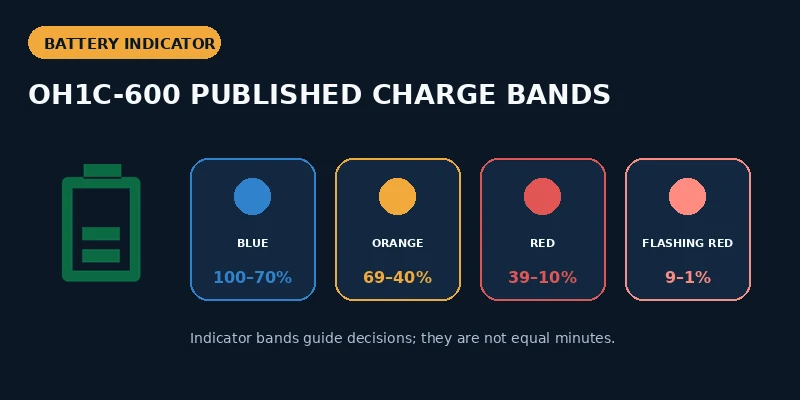
The OH1C-600 documentation lists four charge bands after power-on: blue for 100–70 percent, orange for 69–40 percent, red for 39–10 percent and flashing red for 9–1 percent. These bands let a rider decide whether to recharge before departure or reduce output before entering a long dark segment.
Percentage bands do not translate directly into equal minutes. High mode consumes energy faster than low, and the discharge curve may not be linear. Treat the indicator as a planning signal, not a precise clock. For a repeat commute, note how the light behaves on the actual route and recharge before the remaining band becomes marginal for the return leg.
For buyers, test whether indicator thresholds match the approved firmware and whether colour is distinguishable in bright and dark conditions. The published legend, product interface and manual should use the same ranges.
OH1C-600 Bicycle Light Battery Runtime: A Verified Steady-Mode Example
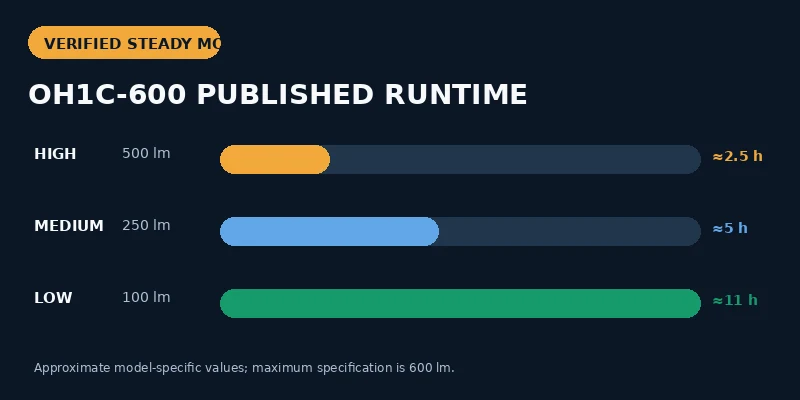
The current OH1C-600 bicycle front light provides a transparent steady-mode example. Its published specification lists a 2,500 mAh 18650 battery and the following approximate runtimes:
| Steady mode | Published output | Published runtime | Practical comparison question |
|---|---|---|---|
| High | 500 lm | About 2.5 h | Does this mode cover the darkest segment plus a reserve? |
| Medium | 250 lm | About 5 h | Is the beam sufficient on lit and mixed routes? |
| Low | 100 lm | About 11 h | Is this a visibility/fill mode or adequate route illumination? |
These rows demonstrate why “maximum 600 lumens” is not the same as “600 lumens for 2.5 hours.” The page lists 600 lumens as the maximum specification and 500 lumens as the high steady mode. Keep those facts separate in sales copy, schema and comparison tables.
The page also publishes flash-mode runtimes, but its specification table and control-operation text use different output labels for those flash modes. The public article therefore does not repeat the disputed flash lumen values. CONWICO should reconcile the website, manual and firmware specification before adding a full five-mode table. Excluding a conflicting value is more credible than selecting the most favorable version.
Finally, the published runtimes are approximate model specifications. They should not be turned into guaranteed real-world hours without the documented test conditions and production-sample verification.
Bike Light Battery Runtime Checklist for Riders and Buyers
Use this bike light battery runtime checklist before purchasing, specifying or approving a product:
- Record the longest expected time in darkness and add a practical reserve.
- Identify the lowest steady mode that still provides a useful beam for the route and speed.
- Compare runtime for that mode, not the longest flash or economy claim.
- Separate maximum output, sustained steady output and short boost modes.
- Request a runtime curve and test endpoint when consistent output matters.
- Record battery capacity, format and nominal voltage, but do not convert mAh directly into hours.
- Check the active-mode display and low-battery behavior.
- Confirm charging input, charge time, cable requirements and pass-through operation individually.
- Test the mount, water protection and charging-port cover as part of the same use case.
- Reconcile the product page, manual, firmware and packaging before mass production or publication.
For buyers, the last step is crucial. A technically correct mode table can still create customer confusion if the manual and web page use different numbers. One approved specification source should control every channel.
Bike Light Battery Runtime FAQ
How long should a rechargeable bike light last?
It should last longer than the time you expect to ride in darkness while using the required mode. Compare the exact steady-mode runtime and leave a reserve; do not choose by the maximum “up to” figure alone.
Why does my bike light battery run out faster on high mode?
High mode drives the LED at greater power, so it consumes stored energy faster and may also create more heat. Medium and low modes generally extend runtime, but the relationship is not perfectly proportional.
Does a bigger mAh battery always give longer bike light runtime?
Not necessarily. Capacity helps when voltage and system design are comparable, but LED power, driver efficiency, regulation, temperature and mode programming also affect runtime. Compare tested mode tables.
Are flashing bike light modes better for battery life?
They often last longer because average power is lower, but they serve visibility rather than continuous road illumination. Use the mode appropriate for the route and local rules.
Does USB-C mean a bike light charges faster?
No. USB-C identifies the connector. Charging speed depends on the product’s supported input, charger, cable and charging design. Check the stated voltage/current and charge time.
Can I use a bicycle light while it is charging?
Only if the manufacturer explicitly supports pass-through operation. Some products cannot run while charging or restrict the available output. Verify the exact model before relying on a power bank.
How much bike light battery runtime reserve should I plan?
A 25–50 percent time margin is a useful planning convention for delays and changing conditions, not a guarantee. Remote, cold or technically demanding rides may justify more reserve and a backup light.
Choose Bicycle Light Battery Runtime by Required Mode
Choose bicycle light battery runtime by the steady mode that makes the route usable, then verify sustained output, test method, indicator behavior and charging. Capacity and connector type support that decision, but neither one predicts the ride on its own.
Use the verified OH1C-600 steady-mode table as a reference and request the runtime curve, charge-time data and reconciled flash-mode specification before procurement. To move from runtime planning to complete light selection, continue with the guide to bike lights for night riding and explore the full bicycle lights range.