Table Of Contents
What Should Buyers Include in a Custom Bicycle Light RFQ?
A custom bicycle light RFQ should tell a supplier exactly what is being quoted, where the product will be sold, how riders will use it, which requirements are mandatory and which decisions remain open. At minimum, include the product type, target market, riding scenario, beam and mode requirements, runtime, battery and charging, mounting, housing, weather exposure, controls, branding, packaging, documents, sample plan, test evidence, quantities and required dates. Ask the supplier to identify assumptions, alternatives and exclusions in the same response.
That level of detail does not lock every engineering decision before feasibility review. It creates a controlled starting point. Suppliers can recommend a suitable platform or development route, while buyers can compare proposals without discovering later that one quote excludes a mount, retail package, test, battery document or tooling charge. This page stays focused on the RFQ itself; for the wider development process that follows the inquiry—from optical decisions to sample approval and production control—see the custom bicycle light development checklist.
What Should a Custom Bicycle Light RFQ Include? The Short Answer
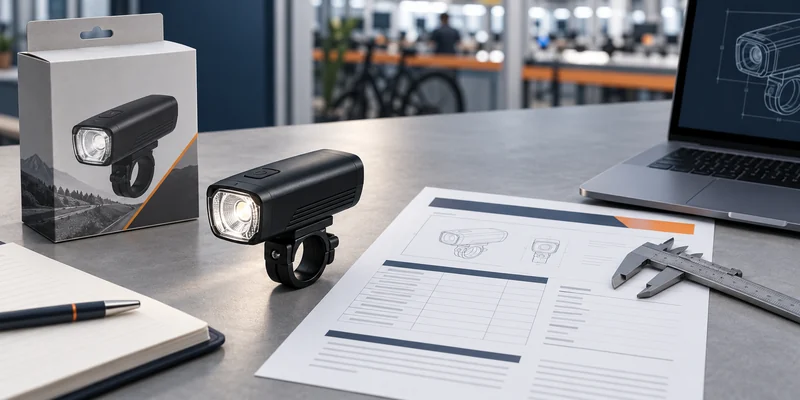
The shortest useful answer is: define the market and rider, the physical product, the performance target, the acceptance evidence and the commercial basis. A buyer should send one revision-controlled sheet supported by relevant drawings, reference samples and artwork. Every field should be marked required, target, open to recommendation or not applicable. The bicycle light supplier should answer against the same revision and flag any departure from it.
For a front light, the RFQ normally needs beam purpose and distribution, maximum and sustained output, operating modes, runtime by mode, battery system, charging input, mounting dimensions, housing and water-ingress requirements. A custom bike tail light may instead prioritize viewing angles, day/night signaling, seatpost or rack fit, mode logic and any sensing functions. For either product, the package must also define logo, finish, included accessories, manual and labels, sample approval, test records, quantity breaks, target timing and delivery basis.
Define the Custom Bicycle Light RFQ Project and Quote Basis
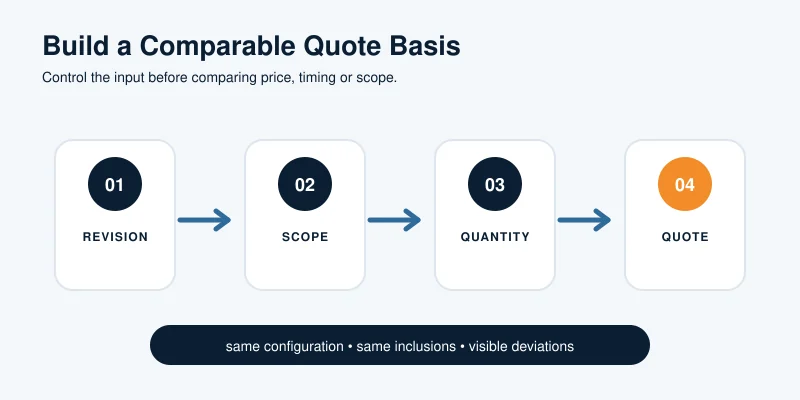
Start the custom bicycle light RFQ with a project name, document revision, issue date and approval owner. Identify whether the request is for an existing model with logo and packaging, an existing platform with approved functional changes, or a new product requiring optical, electrical, mechanical or industrial-design work. Those routes carry different engineering, tooling, testing and schedule implications. A supplier should not have to infer the intended scope from a product photo.
State the destination countries, sales channel and planned launch window. Add the initial order quantity, expected annual range if useful and the quantity tiers you want priced. If the final quantity is not fixed, provide a realistic range rather than asking for one price with no volume basis. Request that the quotation state currency, trade term and named place, quote validity, payment assumptions, sample charges, non-recurring engineering or tooling, unit packaging and any separately priced tests or documents.
Version control matters once alternatives appear. If one proposal changes the cell, optic, mount or package, label it as a deviation or optional line rather than silently replacing the RFQ requirement. The buyer can then compare the base requirement, the supplier’s recommended alternative and the cost or schedule effect of each.
Describe the Bicycle Lights Market, Rider and Use Case
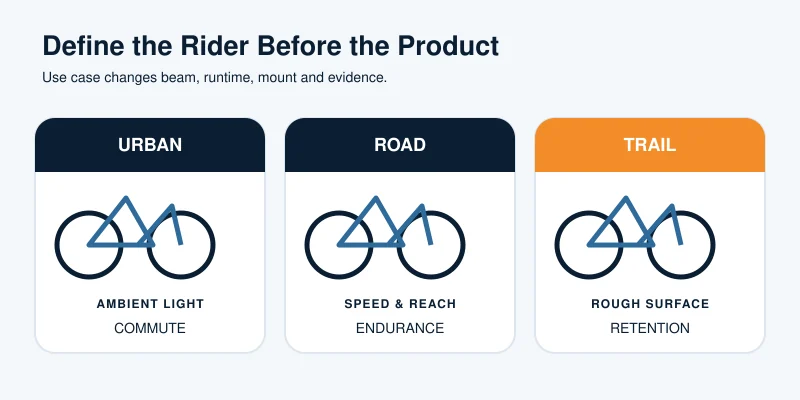
Bicycle lights should be specified around the job they must perform. Define the rider segment, typical speed, ride duration, road or trail surface, ambient light, weather exposure and mounting position. State whether the main task is seeing the road, being seen by others or both. A compact urban-commuter light, a mountain-bike trail light and a daytime warning light can use different beam distributions, modes, mounts and power strategies even when their headline lumen figures look similar.
Identify the product type clearly: bicycle front light, rear light, front-and-rear set, helmet light or another configuration. For an e-bike-connected product, include the available input and interface information. For a self-contained rechargeable model, state whether the battery should be built in or replaceable. Do not describe a reference product as though every feature must be copied; annotate which attributes explain the desired size, appearance, user interface or performance.
The target market belongs in the technical brief because product claims, labels, battery shipping documents and bicycle-light requirements can differ by destination. Ask the supplier to confirm which documents apply to the exact model and configuration. Do not request “CE, RoHS, FCC, StVZO and all certificates” as a generic line with no market, product scope or evidence requirement.
Set Bicycle Front Light Output, Beam and Mode Requirements
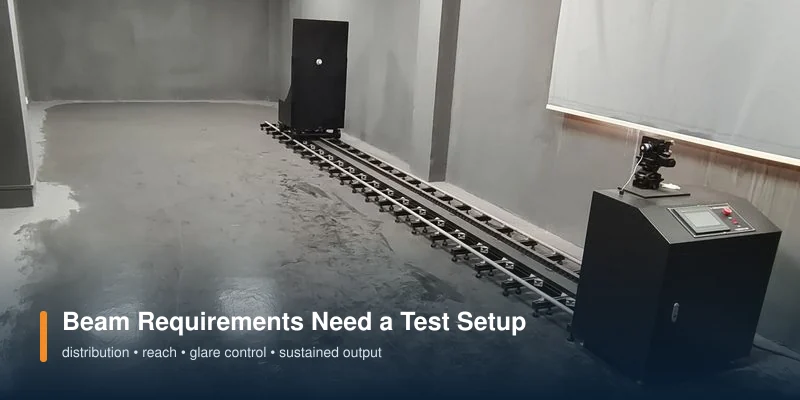
A bicycle front light RFQ needs more than a peak lumen target. Lumens describe total luminous flux, while riders experience where the light is placed, how evenly the foreground is lit, how far the useful beam reaches and whether it creates glare. Define the intended beam task, width and reach, near-field coverage, side visibility and any cutoff or glare-control objective. If the buyer needs a specific lux level, measuring distance or beam image, state the method and test setup.
Separate maximum output from sustained output after the light has reached its normal operating temperature. Define the modes that matter, their order, memory behavior, lockout and any automatic step-down or low-battery response. For bicycle LED lights with a brief high-output mode, ask the supplier to show the output-versus-time behavior instead of quoting the peak as though it lasts for the entire runtime.
The response should identify the sample version, battery condition, ambient conditions, mode, measurement equipment or method and acceptance threshold. A beam photograph is useful only when the light, distance, camera settings and target surface are controlled. This makes the evidence comparable and gives packaging and web teams defensible claims.
Specify Rechargeable Bike Light Battery, Runtime and Charging
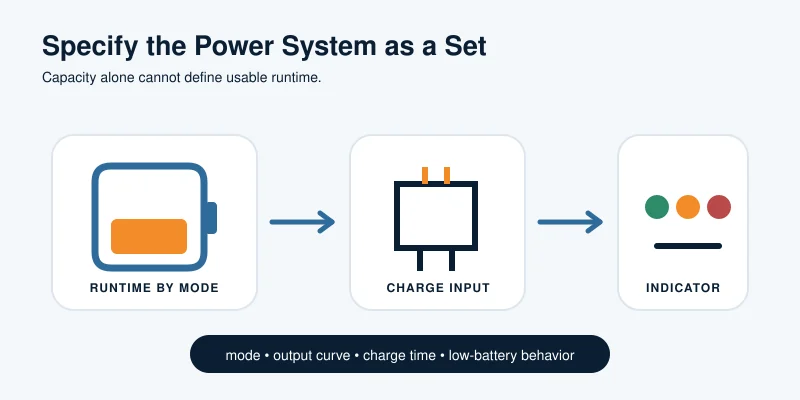
For a rechargeable bike light, state the required runtime for each important steady mode and the minimum useful output expected during that period. Battery capacity in milliamp-hours is supporting information, not a direct promise of hours. Runtime also depends on LED power, driver efficiency, thermal regulation, cell condition and mode logic. Ask for a mode table and, where performance is critical, an output curve with the test endpoint defined.
The RFQ should identify the preferred cell type and configuration, built-in or replaceable architecture, charge connector, rated charging input, target charge time, battery indicator and low-battery behavior. For USB rechargeable bike lights, a USB-C receptacle does not by itself establish fast charging, USB Power Delivery or operation while charging. List those functions only if required, and ask the supplier to confirm and test them. Also define whether a cable, adapter or spare battery is included.
For battery-containing shipments, request the documents and pack information relevant to the exact cell and finished configuration, destination and transport route. The buyer should not assume that a report for a similar cell or another model covers the order. Keep transport evidence, product performance evidence and market-compliance documents as separate RFQ rows so each can be verified.
Define Bicycle Light Mounting, Housing and Weather Protection
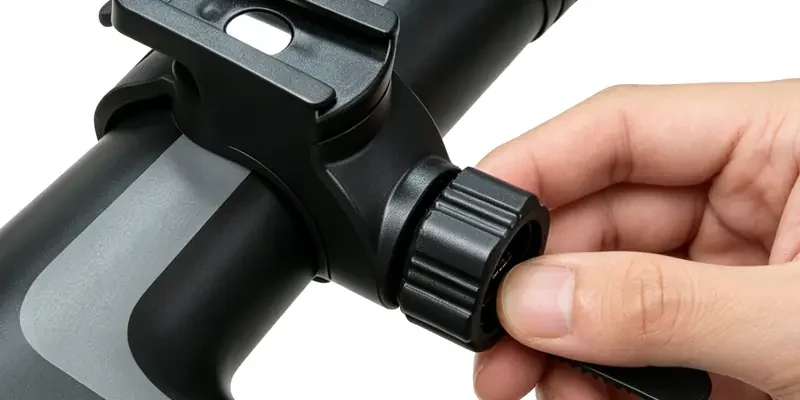
The bicycle light mount controls where the beam stays during a ride. Record the mounting location, compatible handlebar, seatpost, rack or helmet dimensions, installation method, angle range, quick-release behavior and any tool requirement. Define retention expectations during vibration and repeated installation, plus the acceptable movement, wear or release condition. If the light must fit an aero profile or share cockpit space with another device, include a drawing or measured interface.
Describe the housing material, finish, color reference, target dimensions and weight only where they are genuine constraints. Identify touch surfaces, button access with gloves, port-cover handling, lens protection and heat-sensitive areas. For new structures, mark critical dimensions and the mating part or datum used for inspection.
Weather protection must use a specific verified rating or project test, not a word such as “waterproof.” State the intended exposure and the required post-test function. If IPX6 is requested, remember that the X does not provide a dust rating. Ask which standard edition, configuration, sample count and method will support the claim, and do not extend one model’s result across unrelated bicycle lights.
Detail Custom Bike Light Branding, Packaging and Documents
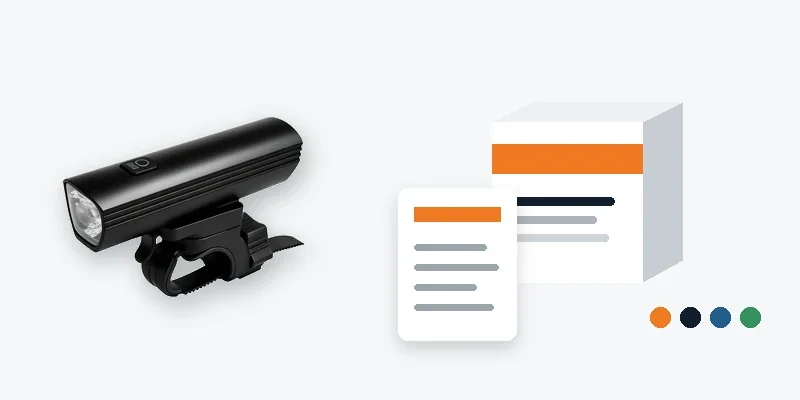
Custom bike light branding should be treated as controlled product data. Supply vector artwork, logo dimensions, position, application method, color reference and any surface-finish sample. Ask for an artwork proof and an approved appearance sample. If color matching is important, define the reference and acceptable evaluation method instead of relying on an uncalibrated screen image.
Define every item in the retail and shipping pack: light, mount, adapters, cable, fasteners, battery, manual and any spare part. Specify unit box style, inserts, barcode ownership, labels, languages, warnings and master-carton requirements. Online sellers should also identify any marketplace label or pack-content constraint early, because it can affect artwork, carton planning and quotation.
List the documents the supplier must return, with the exact model and configuration expected on each. These may include a controlled specification, mode table, drawing, bill-of-material reference, manual, artwork proof, test report or battery transport document. Product claims for output, runtime, charging, materials and water resistance should match across the approved specification, manual, box, website and marketplace listing.
Ask a Bicycle Light Supplier for Samples and Test Evidence
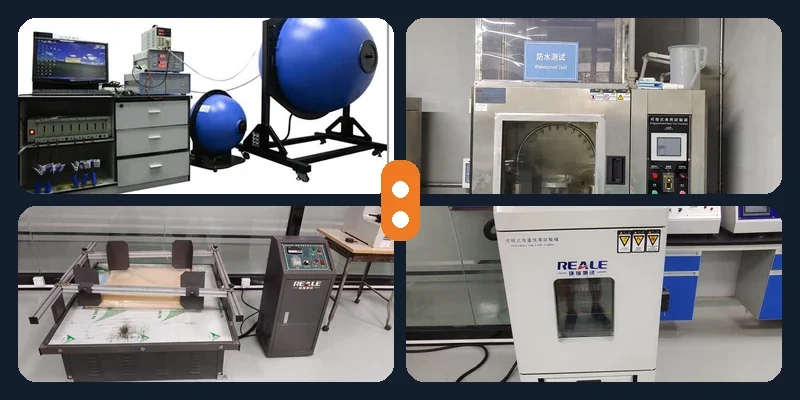
A bicycle light supplier should know what the sample must prove. State whether you need an appearance sample, functional sample, validation sample or production-equivalent sample. Give every sample an identifier and configuration, then record open issues and approval status. A signed sample without a linked specification can become ambiguous when components, firmware, finish or packaging change.
Build acceptance criteria from the RFQ requirements. Relevant checks may include luminous output and beam distribution, runtime by mode, charging behavior, battery indication, temperature, water exposure, mount retention, drop, vibration, connector cycling, button life and packaging inspection. Not every project needs every test. The test plan should identify the sample version, equipment or method, conditions, result, pass/fail rule and reviewer.
An equipment list shows available capability; it does not prove that the quoted SKU passed a test. Ask for model-specific records and identify whether testing is internal or performed by a third party. If a document is required for a destination market, request its title, issuing body where relevant, model/configuration scope, date and status before using the claim in retail content.
Give the Bicycle Light Manufacturer a Comparable Quote Format
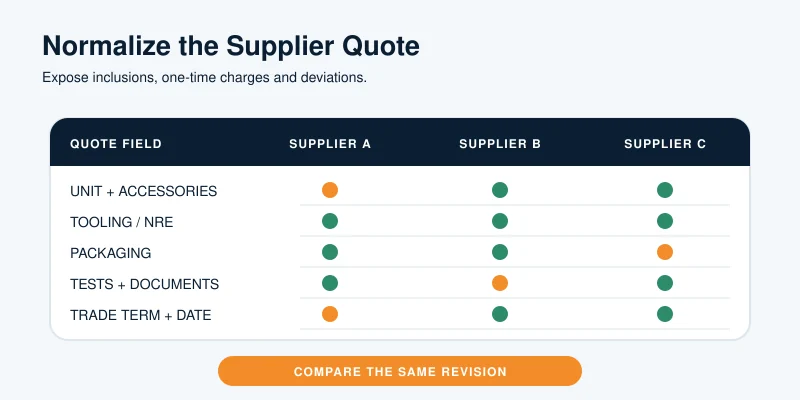
Ask each bicycle light manufacturer to return the same commercial table. Unit price should identify the model revision, quantity tier, included accessories, battery, package and trade term. Separate sample fees, tooling or non-recurring engineering, logo or finish setup, custom package, testing, documentation and freight. A low unit price is not comparable if critical items are excluded or based on a different specification.
Dates also need definitions. Request estimated timing for feasibility feedback, samples, buyer review, tooling or revision work, pilot or production preparation, mass production and goods-ready status. Keep transport time separate. MOQ and lead time depend on the platform, customization, process, components and order configuration, so the RFQ should ask the supplier to confirm them for the project rather than relying on a universal website number.
Require a clear assumptions-and-exclusions section. Open decisions should have an owner and due date. If a supplier recommends an alternative, the response should explain which requirement changes and whether price, performance, evidence, tooling or schedule changes with it.
Copy This Custom Bicycle Light RFQ Checklist
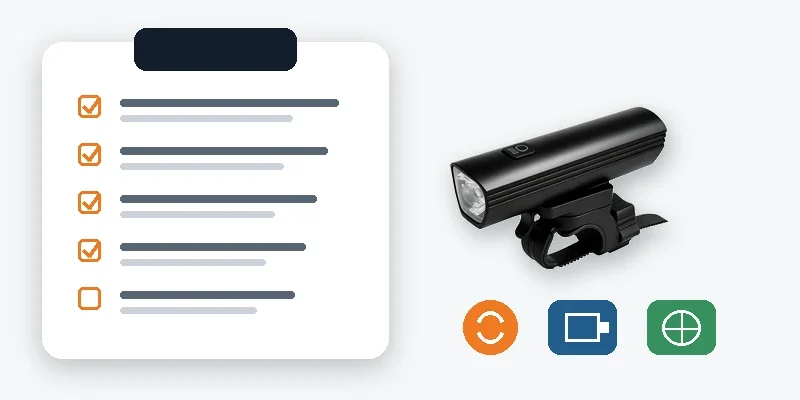
Use the following table as the front sheet of the inquiry. Attach controlled files where a field needs drawings, artwork or a full test method.
| RFQ section | Buyer input | Supplier response required |
|---|---|---|
| Project control | Project name, revision, issue date, buyer and approval owner | Quote revision and any superseded file identified |
| Market and use | Countries, channel, rider, terrain, speed, ride duration and weather | Proposed model/development route and limitations |
| Product scope | Front, rear, set or other; existing platform or new development | Base model/configuration and customization scope |
| Optical requirements | Beam task, modes, maximum and sustained output, distribution and glare objective | Values, method, assumptions and deviations |
| Battery and charging | Runtime by mode, cell architecture, connector, input, indicators and included cable | Confirmed system, mode table and evidence plan |
| Mount and housing | Location, fit dimensions, retention, angle, materials, finish and controls | Drawings, tolerances, proposed materials and sample plan |
| Environment and testing | Water, temperature, drop, vibration, cycling and acceptance needs | Applicable method, sample count, internal/third-party scope and report |
| Branding and packaging | Logo, color, pack contents, box, labels, barcode, manual and languages | Artwork process, included items and pack quotation |
| Documents | Specifications, drawings, reports, declarations and battery records needed | Exact model/configuration coverage and delivery stage |
| Commercial basis | Quantity tiers, annual range, target timing, destination and trade-term request | Itemized price, MOQ, lead-time stages, validity, payment assumptions and exclusions |
Custom Bicycle Light RFQ FAQ
What information does a bicycle light supplier need to quote?
Provide the market, use case, product type, required functions, beam and runtime targets, battery and charging, mount, housing, weather exposure, branding, packaging, documents, sample and test expectations, quantities and timing. Mark mandatory, target and open items so the supplier knows where it can recommend alternatives.
Can I request a custom bike light quote without final specifications?
Yes, if the open decisions are explicit. Give the supplier the rider, market, performance targets, constraints and reference products, then request a feasibility proposal with assumptions and options. Quotes are not directly comparable until the proposed configurations are aligned.
Should MOQ and lead time be included in a custom bicycle light RFQ?
Ask the supplier to confirm both for the exact scope. MOQ and timing can change with the base model, functional changes, tooling, components, artwork, package, testing and quantity. Avoid publishing or budgeting from a universal figure that has not been confirmed for the project.
How should buyers compare bicycle light manufacturer quotations?
Compare the same revision, configuration, quantity, accessories, battery, package, tests, documents and trade term. Review one-time charges, assumptions, exclusions and evidence status alongside unit price. Normalize alternatives before selecting a supplier.
Do I need a bicycle light sample before mass production?
Yes. The buyer should approve a clearly identified sample and its linked specification, while recording what was evaluated and which issues remain. A sample approval does not replace production controls or model-specific test evidence.
Send a Comparable Custom Bicycle Light RFQ
A strong custom bicycle light RFQ makes scope visible. It tells suppliers what the rider and market need, which results must be measured, what the quote must include and how the sample will be approved. The result is not merely a faster price; it is a defensible basis for feasibility review, supplier comparison and later production control.
CONWICO supports OEM/ODM discussions for bicycle lights and related portable lighting products. Send the completed RFQ through the CONWICO contact page with the target market, product type, quantity range, required timing and controlled attachments. The team can then review the requested scope and identify the information or samples needed for the next step.